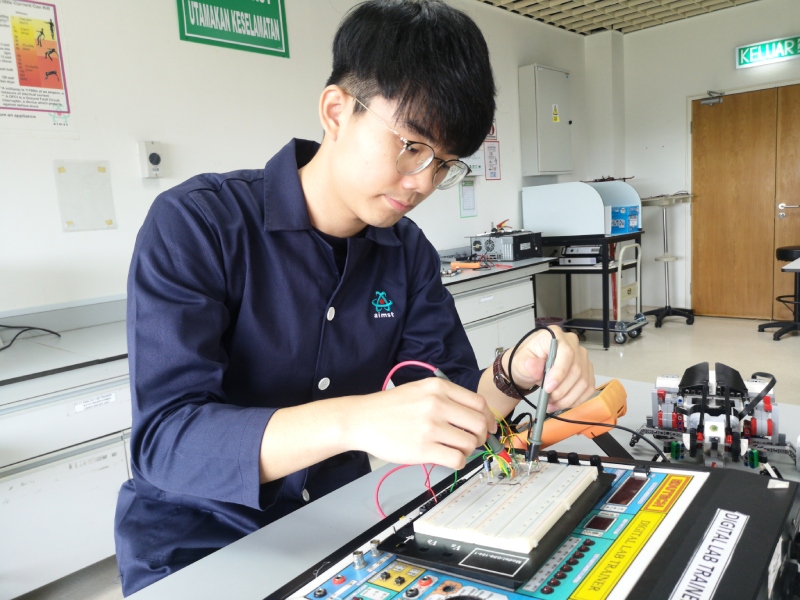
Electrical and Electronics Engineering
Starting From
₹52,000 /- Per Year

About Course
Electrical and Electronics Engineering (EEE) is a vast and dynamic field that encompasses the study, design, and application of electrical systems, electronics, and electromagnetism. It plays a crucial role in numerous sectors, including power generation, telecommunications, electronics manufacturing, and automation. The discipline is centered around understanding how electrical energy can be generated, transmitted, and utilized efficiently and how electronic systems can be designed and implemented to perform various functions.
At its core, Electrical Engineering focuses on the generation, distribution, and utilization of electrical power. This includes the design and maintenance of power systems, transformers, generators, and electrical circuits. Engineers in this field work on improving power generation methods, enhancing the efficiency of power transmission, and ensuring the reliability of electrical systems. They also deal with high-voltage engineering, power electronics, and renewable energy systems, making significant contributions to sustainable energy solutions.
Electronics Engineering, a subset of EEE, deals with the design and development of electronic devices and systems. This includes everything from consumer electronics, like smartphones and laptops, to complex systems used in telecommunications, medical equipment, and industrial automation. Electronics engineers work on circuit design, semiconductor devices, embedded systems, and signal processing. They are involved in creating innovative solutions and improving existing technologies to meet the demands of modern society.
EEE encompasses several specializations, such as power systems, control systems, communication systems, microelectronics, and instrumentation. Control systems focus on the design of systems that manage and regulate processes in various applications, from industrial automation to aerospace. Communication systems engineers work on the design and implementation of communication networks, including satellite, mobile, and optical communication technologies. Microelectronics deals with the design and fabrication of small electronic components and integrated circuits, while instrumentation involves developing devices to measure and control physical quantities.
The field of EEE is known for its rapid technological advancements and its impact on everyday life. Innovations in this field drive progress in various industries, including healthcare, automotive, aerospace, and manufacturing. Engineers in EEE often work in research and development, designing new technologies, improving existing systems, and solving complex engineering problems. They may work for technology companies, research institutions, government agencies, or as consultants in various industries.
Overall, Electrical and Electronics Engineering is a critical and ever-evolving discipline that underpins much of modern technology. It offers a broad range of career opportunities and continues to be at the forefront of technological innovation and development.

Course Scope
Electrical and Electronics Engineering (EEE) is a broad and versatile field that offers a wide range of career opportunities and scope for growth. The scope of EEE can be understood in terms of career prospects, industries, and future trends.
Career Prospects
Core Electrical Engineering Roles:
Power Generation and Distribution: Engineers in this field work on the design, maintenance, and improvement of power plants, electrical grids, and distribution systems.
Electrical Design Engineer: They design electrical systems for various applications including residential, commercial, and industrial settings.
Maintenance Engineer: Responsible for ensuring that electrical equipment and systems are operating efficiently and safely.
Electronics Engineering Roles:
Embedded Systems Engineer: Focus on designing and developing embedded systems, which are integral to modern electronic devices.
Communication Engineer: Work with communication systems, including wireless, satellite, and fiber optic networks.
VLSI Design Engineer: Specialize in the design of integrated circuits (ICs) and semiconductor devices.
Interdisciplinary Roles:
Automation and Control Engineer: Design and implement automated systems and control processes in manufacturing and production.
Robotics Engineer: Develop and maintain robotic systems for various applications including manufacturing, healthcare, and exploration.
Renewable Energy Engineer: Work on the development and implementation of renewable energy systems such as solar, wind, and hydroelectric power.
Industries
Energy and Power:
Companies involved in power generation, transmission, and distribution, including public utilities and private energy firms.
Renewable energy companies focusing on solar, wind, and other sustainable energy sources.
Electronics and Semiconductors:
Manufacturers of electronic components, consumer electronics, and communication devices.
Semiconductor companies involved in the design and fabrication of microchips and integrated circuits.
Automotive and Aerospace:
Companies developing electric vehicles, autonomous driving systems, and advanced aerospace technologies.
Opportunities in the design and implementation of electrical systems within vehicles and aircraft.
Telecommunications:
Telecom companies providing wired and wireless communication services.
Roles in network design, maintenance, and improvement.
IT and Software:
IT firms and startups working on embedded systems, IoT, and other technology-driven solutions.
Software development roles related to automation, control systems, and communication technologies.
Future Trends
Renewable Energy and Smart Grids: Increasing focus on sustainable energy sources and smart grid technology will create new opportunities in power systems engineering.
Internet of Things (IoT): Growth in IoT applications will drive demand for engineers skilled in embedded systems and wireless communication.
Electric Vehicles (EVs): Expansion of the EV market will require expertise in battery technology, power electronics, and vehicle automation.
Automation and Robotics: Advances in automation and robotics will open up roles in industrial automation, smart manufacturing, and AI-driven control systems.
5G and Beyond: Development of next-generation communication technologies will require engineers to work on 5G networks, satellite communication, and related fields.
Conclusion
The scope of Electrical and Electronics Engineering is vast and continually evolving, offering diverse opportunities across various industries. The field's integration with emerging technologies and its crucial role in modern infrastructure ensure a dynamic and rewarding career path for EEE graduates.

Course Syllabus & Subjects
Electrical and Electronics Engineering (EEE) is a comprehensive field that covers a wide range of subjects, equipping students with the necessary skills and knowledge to excel in various industries. Below are the key subjects typically included in an EEE curriculum:
Core Subjects
Basic Electrical Engineering:
- Fundamentals of electric circuits, Ohm’s Law, Kirchhoff’s Laws.
- AC and DC circuits, series and parallel circuits.
Electrical Machines:
- Transformers, generators, and motors.
- Principles of operation, performance, and control.
Power Systems:
- Generation, transmission, and distribution of electric power.
- Load flow studies, fault analysis, and stability of power systems.
Control Systems:
- Feedback systems, stability, and control.
- Transfer functions, PID controllers, and state-space analysis.
Analog and Digital Electronics:
- Semiconductor devices, diodes, transistors, and operational amplifiers.
- Logic gates, flip-flops, multiplexers, and microprocessors.
Electromagnetic Field Theory:
- Maxwell’s equations, wave propagation.
- Electromagnetic fields and waves, transmission lines.
Electrical Measurements and Instrumentation:
- Measurement of voltage, current, power, and energy.
- Use of instruments like oscilloscopes, multimeters, and transducers.
Power Electronics:
- Converters, inverters, and power semiconductor devices.
- Applications in motor drives, renewable energy systems.
Advanced and Specialized Subjects
Embedded Systems:
- Microcontrollers, interfacing, and real-time systems.
- Programming and application development for embedded devices.
Renewable Energy Systems:
- Solar, wind, and hydroelectric power generation.
- Integration of renewable energy sources with the grid.
Digital Signal Processing (DSP):
- Signal sampling, transformation, and filtering.
- Applications in communication and control systems.
VLSI Design:
- Design and fabrication of integrated circuits.
- CMOS technology, layout design, and testing.
Communication Systems:
- Analog and digital communication techniques.
- Modulation, demodulation, and information theory.
Robotics and Automation:
- Robot kinematics and dynamics.
- Control and programming of robotic systems.
Laboratory and Practical Subjects
Electrical Machines Lab:
- Practical experiments on transformers, motors, and generators.
- Performance testing and control techniques.
Electronics Lab:
- Circuit design, simulation, and testing.
- Use of breadboards, PCB design, and soldering techniques.
Power Systems Lab:
- Simulation of power system operations.
- Load flow analysis, relay coordination, and fault studies.
Control Systems Lab:
- Implementation of control algorithms.
- Testing of controllers and system response analysis.
Microprocessor and Microcontroller Lab:
- Programming and interfacing of microcontrollers.
- Development of embedded applications.
Project Work and Seminars
- Minor and Major Projects: Real-world problem-solving projects in the final year.
- Seminars and Workshops: Presentations on current trends and advancements in the field.
These subjects collectively provide a strong foundation in both theoretical and practical aspects of electrical and electronics engineering, preparing students for a wide range of career opportunities and advanced studies.
Questions about the Electrical and Electronics Engineering?
Let our experts provide the answers – talk to us today!


Course Eligibility
The eligibility criteria for a Bachelor of Technology (B.Tech) or Bachelor of Engineering (B.E.) degree in Electrical and Electronics Engineering (EEE) typically include the following:
Educational Qualification:
- Candidates must have completed their higher secondary education (10+2) or equivalent with Physics, Chemistry, and Mathematics as core subjects.
- A minimum percentage of marks in the 10+2 examination is usually required, which may vary between institutions but is typically around 50-60%.
Entrance Examinations:
- Admission to EEE programs is often based on performance in national, state, or university-level entrance examinations.
- Common entrance exams in India include the Joint Entrance Examination (JEE) Main and JEE Advanced for admission to IITs, NITs, and other centrally funded technical institutions.
- State-level entrance exams like the Maharashtra Common Entrance Test (MHT-CET), Karnataka Common Entrance Test (KCET), and Tamil Nadu Engineering Admissions (TNEA) are also commonly used.
- Some private universities and institutions may conduct their own entrance exams or consider scores from exams like the Birla Institute of Technology and Science Admission Test (BITSAT) or the Vellore Institute of Technology Engineering Entrance Exam (VITEEE).
Age Limit:
- There may be an age limit for applicants, which is usually between 17 and 25 years at the time of admission. However, this can vary based on the institution and region.
Additional Requirements:
- Some institutions may have additional requirements such as a minimum score in English or other language subjects.
- Certain universities might also require candidates to participate in a counseling or interview process after clearing the entrance exam.
Reservation Criteria:
- Reservation policies as per government regulations for categories like SC/ST/OBC, economically weaker sections (EWS), and persons with disabilities (PWD) may also apply.
It's important for candidates to check the specific eligibility criteria of the institutions they are interested in, as these can vary. Prospective students should also stay updated on application deadlines and entrance exam dates to ensure they meet all necessary requirements for admission.

Course Level
Confused about the course content?
Get clarity from our experts – start the conversation!
Similar Courses
Recruiters
Top Recruiters:
Power and Energy Sector
General Electric (GE):
- A multinational conglomerate known for its work in power generation, energy management, and renewable energy.
Siemens:
- A global company specializing in electrification, automation, and digitalization, with a significant focus on energy-efficient technologies.
Schneider Electric:
- A leader in energy management and automation, offering products and solutions for energy and process management.
ABB Group:
- Provides technologies for electrification, robotics, automation, and motion, serving a wide range of industries.
NTPC Limited:
- India's largest energy conglomerate involved in power generation and allied activities.
Electronics and Semiconductor Sector
Intel:
- A global leader in semiconductor manufacturing and microprocessor technology.
Texas Instruments:
- Known for its design and manufacturing of semiconductors and integrated circuits.
Samsung Electronics:
- A major player in electronics and information technology, with a focus on semiconductor products.
Qualcomm:
- Specializes in telecommunications products and services, with a significant presence in semiconductor technology.
IT and Telecommunications
Tata Consultancy Services (TCS):
- An IT services and consulting company offering a wide range of services across various industries.
Infosys:
- Provides IT consulting and services, including engineering services for EEE graduates.
Wipro:
- An IT services company that also provides engineering services in electronics and electrical engineering.
Cognizant:
- Known for its IT services and consulting, with opportunities in embedded systems and automation.
Bharti Airtel:
- A leading global telecommunications company with opportunities in network management and telecom infrastructure.
Renewable Energy Sector
Suzlon Energy:
- Specializes in wind energy solutions and is one of the leading renewable energy companies in India.
Adani Green Energy:
- Focuses on renewable power generation, particularly in solar and wind energy.
First Solar:
- A global provider of comprehensive photovoltaic (PV) solar energy solutions.
Manufacturing and Automation
Honeywell:
- Provides products and services in aerospace, building technologies, performance materials, and safety and productivity solutions.
Rockwell Automation:
- Specializes in industrial automation and information technology.
Bosch:
- A global provider of technology and services in industrial technology, consumer goods, and building technology.
Government and Public Sector
Bharat Heavy Electricals Limited (BHEL):
- An engineering and manufacturing company involved in the design, engineering, manufacturing, construction, testing, commissioning, and servicing of a wide range of products and services for core sectors of the economy.
Power Grid Corporation of India:
- Engaged in the transmission of electric power across India.
Research and Development
Indian Space Research Organisation (ISRO):
- The space agency of the Government of India, providing opportunities in space research and satellite technology.
Defence Research and Development Organisation (DRDO):
- Engages in research and development in the field of defense technology.
Don't let doubts hold you back.
Connect with our experts to resolve any course questions!
Popular Courses

Btech Computer Science
Starting at -/₹144,555
Btech Civil Engineering
Starting at -/₹23,000
MBA Banking Management
Starting at -/₹NaN
MA History
Starting at -/₹140,000
BA Philosophy
Starting at -/₹10,000
BS Bio Engineering
Starting at -/₹54,000Popular Colleges
![Army College of Dental Sciences - [ACDS], Secunderabad](https://dekhocampus.s3.ap-south-1.amazonaws.com/college-banner/banner_39829-20231226T125957343Z-001992.jpg)
Army College of Dental Sciences - [ACDS], Secunderabad
Apply Now![Institute of Advanced Management Research - [IAMR], Ghaziabad](https://dekhocampus.s3.ap-south-1.amazonaws.com/college-banner/banner_41311-20231226T125957343Z-001992.jpg)
Institute of Advanced Management Research - [IAMR], Ghaziabad
Apply Now![International Institute of Fashion Design - [INIFD], Pune](https://devdc.s3.eu-north-1.amazonaws.com/1720002993279_image_2024-07-03_160629635.png)
International Institute of Fashion Design - [INIFD], Pune
Apply Now![Indian Institute of Forest Management - [IIFM], Bhopal](https://devdc.s3.eu-north-1.amazonaws.com/1720081628634_image_2024-07-04_135703241.png)
Indian Institute of Forest Management - [IIFM], Bhopal
Apply Now
Banarsidas Chandiwala Institute of Hotel Management & Catering Technology, New Delhi
Apply Now![ICFAI Business School - [IBS], Kolkata](https://dekhocampus.s3.ap-south-1.amazonaws.com/college-banner/banner_89539-20231226T125957343Z-001992.jpg)
ICFAI Business School - [IBS], Kolkata
Apply NowAddress
RZ 43 Sudan Garden, Najafgarh, New Delhi - 110043Opening Hours
Monday - Saturday: 9:00 AM - 07:00 PM
Sunday: 10:00 AM - 06:00 PM