By DekhoCampus Editorial ·
JEE Main Physics Optics (Ray and Wave): Core Strategy & Guide
Master JEE Main Physics Ray and Wave Optics. Explore core concepts, high-yield topics, weightage, and proven revision strategies to maximize your score.

The Joint Entrance Examination (JEE) Main is designed to test a candidate's conceptual clarity, mathematical precision, and spatial visualization. Within the vast Physics syllabus, Optics (Ray and Wave) represents one of the most critical and highly rewarding pillars of preparation. Unlike Mechanics, which can trap students in endless multi-body free-body diagrams, Optics is highly predictable. If you can visualize the geometry of light and recall the correct standard formulas, you can secure these marks swiftly.
Because the National Testing Agency (NTA) strictly enforces a negative marking scheme across both Section A (MCQs) and Section B (Numerical Value Questions), precision is paramount. Mastering Ray and Wave Optics allows you to bank reliable marks and free up crucial minutes for the calculation-heavy Electrodynamics and Thermodynamics sections. This comprehensive guide breaks down the core topics, high-yield formulas, expected weightage, and the exact preparation strategy needed to dominate Optics.
Syllabus Breakdown: What You Need to Master
The Optics unit in JEE Main is cleanly divided into two distinct halves: Geometrical (Ray) Optics and Physical (Wave) Optics. Both demand excellent geometric visualization and rapid formula recall.
Geometrical (Ray) Optics: This section relies on the rectilinear propagation of light and basic geometry. It is historically the heavier of the two halves in terms of question volume.
Reflection and Refraction: You must have a crystal-clear understanding of Snell's Law, apparent depth calculations, and Total Internal Reflection (TIR). TIR applications, especially involving optical fibers and critical angles, are highly tested.
Lenses and Mirrors: The lens maker's formula is a non-negotiable topic that you must master. Practice finding the focal length of complex lens combinations (e.g., silvered lenses or lenses cut into pieces).
Prisms: Focus heavily on prism deviation, specifically the condition for minimum deviation and dispersion through prisms.
Optical Instruments: While occasionally overlooked, microscopes and telescopes (resolving power and magnifying power) can appear as direct, formula-based questions.
Physical (Wave) Optics: Wave Optics explains phenomena that Ray Optics cannot, treating light as an electromagnetic wave.
Interference: Young’s Double Slit Experiment (YDSE) is the absolute core of this chapter and is frequently tested. You must be able to calculate fringe width, identify the position of maxima and minima, and understand what happens when a thin glass slab is introduced into the path of one of the slits.
Diffraction: Understand the single-slit diffraction pattern, focusing on the width of the central maximum and how it differs from YDSE interference patterns.
Polarization: Prioritize Brewster's Law and Malus's Law, as these yield quick, straightforward numerical questions.
High-Yield Topics and Expected Weightage
To ensure your revision is highly optimized, you must focus your time on the areas that historically yield the most questions. Geometrical (Ray) Optics and Wave Optics combined hold a substantial weightage of around 7% to 8% of the entire physics paper.
The table below outlines the expected question distribution in a standard JEE Main shift.
Core Segment | Key Focus Areas for Practice | Expected Questions | Historical Weightage |
Ray Optics | Lens maker's formula, prism deviation, total internal reflection. | 1 - 2 | 4% - 5% |
Wave Optics | YDSE (fringe width, path difference), interference, diffraction. | 1 | 3% - 4% |
Total Optics | Complete Ray & Wave visualization and calculation. | 2 | 7% - 8% |
Candidates can reliably expect 2 questions from this unit per shift.
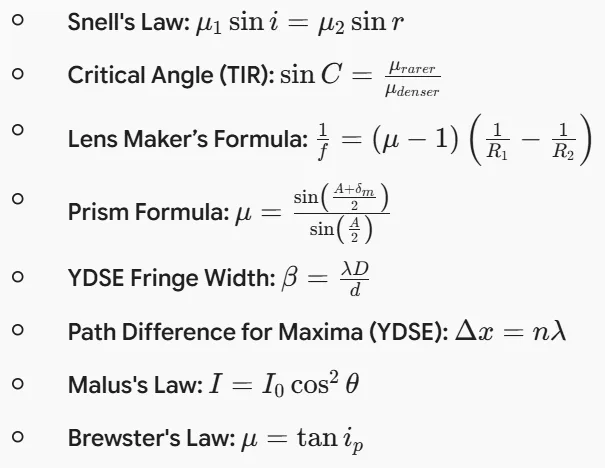
Essential Formulas to Keep at Your Fingertips
Time is your biggest adversary during the Computer-Based Test (CBT). Maintain a dedicated formula sheet and ensure the following relationships are memorized perfectly:
Strategic Preparation and Progress Tracking
To secure the 8 marks typically offered by this unit, your preparation must be incredibly disciplined.
Master the Sign Convention: The most common mistake students make in Ray Optics is misapplying the Cartesian sign convention for mirrors and lenses. Always measure distances from the optical center or pole, and take the direction of incident light as positive.
Draw Ray Diagrams: Never attempt a complex lens or prism problem without drawing a quick, rough ray diagram. Visualizing the path of light drastically reduces setup errors.
Conclusion
Mastering the JEE Main Physics Optics (Ray and Wave) unit is a critical step in securing a top-tier percentile. Because this section relies heavily on geometric visualization and direct formula application, it offers an excellent return on invested study time. Focus heavily on understanding the lens maker's formula, prism deviation, total internal reflection, and YDSE fringe patterns. Keep your sign conventions strict, aggressively practice numericals, and rigorously track your mock test errors. With disciplined practice and rapid formula recall, you can confidently clear these questions and bank crucial time for the tougher mechanics and electrodynamics problems.