By DekhoCampus Editorial ·
JEE Main Physics Heat and Thermodynamics: Core Strategy & Guide
A comprehensive preparation guide for the JEE Main Physics Heat and Thermodynamics unit. Discover the syllabus breakdown, high-yield topics like KTG and Carnot engines, essential formulas, and strategic tips to maximize your score in this o

The Joint Entrance Examination (JEE) Main tests candidates heavily on their ability to manage time and execute calculations accurately under pressure. While mechanics and electromagnetism are incredibly vast and often feature complex, multi-step problems, JEE Main Physics Heat and Thermodynamics stands out as a unique, highly rewarding unit. It is one of the few sections in the entire syllabus where a strong conceptual grasp and direct formula application can guarantee quick, reliable marks.
More importantly, this unit offers a massive strategic advantage: it heavily overlaps with Physical Chemistry. Mastering the laws of thermodynamics, internal energy, and the kinetic theory of gases in Physics simultaneously prepares you for the Chemistry section, essentially offering double the return on your invested study time. For aspirants targeting the 2027 exam cycle, securing a top percentile requires locking down this high-yield block early. This comprehensive guide breaks down the core topics, essential formulas, and the exact preparation strategy needed to dominate Heat and Thermodynamics.
Syllabus Breakdown: What You Need to Master
The Heat and Thermodynamics unit is not a single chapter but a cluster of closely related topics that dictate how thermal energy moves, transforms, and affects matter. The National Testing Agency (NTA) evaluates candidates across three primary domains.
Thermal Properties of Matter and Calorimetry: This foundational segment covers how materials respond to heat. You must master thermal expansion (linear, area, and volume expansion coefficients) and the precise relationship between them. Calorimetry is another heavily tested area. Questions typically involve mixing substances at different temperatures and calculating the final equilibrium temperature. You must have a crystal-clear understanding of specific heat capacity, heat capacity, latent heat of fusion, and latent heat of vaporization.
Heat Transfer: Heat transfer questions evaluate your understanding of how thermal energy travels through different mediums.
Conduction: Focus on the rate of heat flow, thermal conductivity, and the concept of thermal resistance. Problems involving composite rods (rods connected in series or parallel) are extremely common.
Convection: While mathematically less intensive, understanding the conceptual theory is necessary.
Radiation: This is a high-priority area. You must thoroughly understand Stefan-Boltzmann's Law (emissive power), Wien's Displacement Law (relationship between wavelength and temperature), and Newton's Law of Cooling.
Kinetic Theory of Gases (KTG): KTG provides the microscopic explanation for macroscopic thermodynamic behaviors. The NTA loves testing the various speeds of gas molecules: Root Mean Square (RMS) speed, average speed, and most probable speed. Understanding the degrees of freedom for monoatomic, diatomic, and polyatomic gases is non-negotiable, as it directly ties into the Law of Equipartition of Energy and the calculation of specific heats (Cv and Cp).
Thermodynamics: This is the heavyweight champion of the unit. The Zeroth Law establishes temperature, but the First Law of Thermodynamics (Conservation of Energy) is where the calculations begin. You must master the application of the First Law across various thermodynamic processes: Isothermal, Adiabatic, Isobaric, and Isochoric. The Second Law introduces the concepts of reversibility and entropy. Finally, understanding the operational cycles and calculating the efficiency of Heat Engines (specifically the Carnot Engine) and the coefficient of performance for Refrigerators is absolutely mandatory.
High-Yield Topics and Expected Weightage
To ensure your revision is highly optimized, you must focus your time on the areas that historically yield the most questions. The table below outlines the core segments and their expected frequency in a standard JEE Main paper.
Core Segment | Key Focus Areas for Practice | Expected Questions |
Thermodynamics Processes | P-V indicator diagrams, Work done in adiabatic/isothermal processes, First Law applications. | 1 - 2 |
Kinetic Theory of Gases | Degrees of freedom, RMS/average speeds, specific heat ratios ($\gamma$), Equipartition of Energy. | 1 |
Heat Transfer & Calorimetry | Series/parallel thermal resistance, Newton's Law of Cooling, Stefan's Law, mixing of ice and water. | 1 |
Essential Formulas to Keep at Your Fingertips
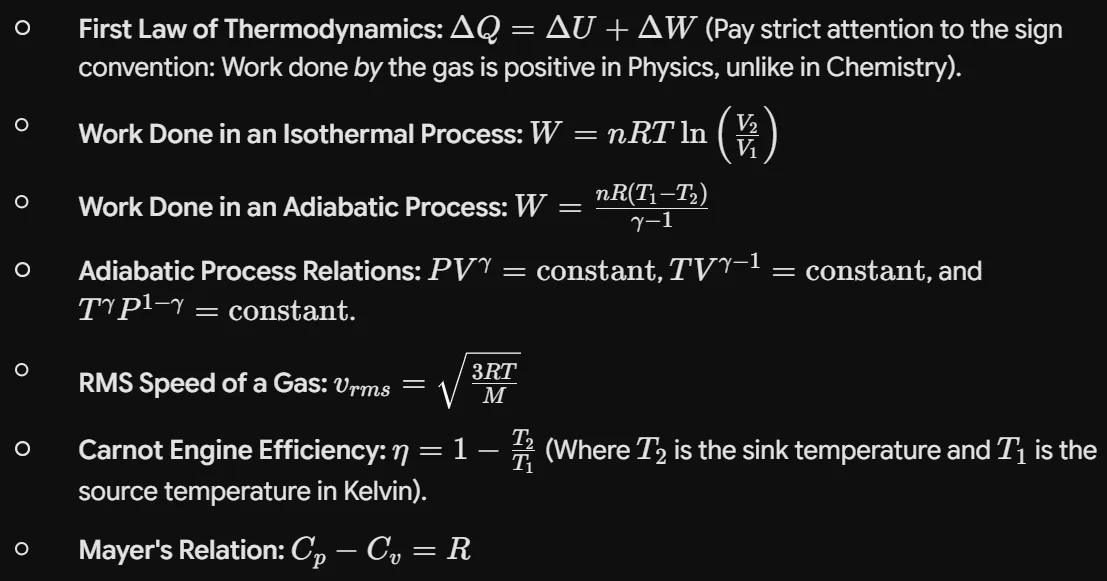
Because time is your biggest adversary during the CBT (Computer-Based Test), you cannot afford to derive formulas from scratch. Maintain a dedicated formula sheet for JEE Main Physics Heat and Thermodynamics and ensure the following relationships are memorized:
Strategic Preparation and Progress Tracking
To secure the 12 to 16 marks typically offered by this unit, your preparation must be incredibly disciplined.
Master P-V Diagrams (Indicator Diagrams): A significant portion of thermodynamics questions will present you with a Pressure-Volume (P-V) graph. You must be able to visually identify the type of process (e.g., a vertical line is isochoric, a horizontal line is isobaric) and calculate the work done by finding the area under the curve. Practice tracing cyclic processes to determine the net work done and whether heat is absorbed or released.
Beware of Sign Conventions: The most common mistake students make is confusing the Physics and Chemistry sign conventions for thermodynamics. In Physics, work done by the system (expansion) is positive, and work done on the system (compression) is negative. Ensure you consciously switch your mindset depending on which section of the paper you are attempting.
Conclusion
Mastering the JEE Main Physics Heat and Thermodynamics unit is a critical step in securing a top-tier percentile. Because this section relies on direct formula application and overlaps significantly with Physical Chemistry, it offers one of the highest returns on invested study time in the entire syllabus. Focus heavily on understanding P-V diagrams, the First Law of Thermodynamics, KTG speed calculations, and Carnot engine efficiencies. Keep your sign conventions straight, rigorously track your mock test errors, and avoid lengthy derivations. With disciplined practice and rapid formula recall, you can confidently clear these questions and bank crucial time for the tougher mechanics and electrodynamics problems.