By DekhoCampus Editorial ·
JEE Main Maths: Calculus Core Strategy & Guide
A comprehensive preparation guide focusing on the Calculus unit for the JEE Main Mathematics paper. Explore high-yield topics like limits, definite integration properties, differential equations, and actionable strategies to secure maximum

For engineering aspirants targeting the Joint Entrance Examination (JEE) Main 2027, the Mathematics section represents the ultimate test of analytical endurance and calculation speed. Within this rigorous section, Calculus stands as the undisputed heavyweight. In fact, Calculus and Algebra together form more than 60% of the math section.
Calculus is the single highest-weightage area in the Mathematics syllabus. Unlike some isolated chapters, Calculus flows in a strict sequential progression. You cannot master integral calculus without a flawless foundation in limits and derivatives. Because the National Testing Agency (NTA) consistently sets highly analytical, multi-step calculation questions in this domain, mastering Calculus is an absolute strategic necessity for securing a top percentile. This comprehensive guide breaks down the core syllabus, high-yield formulas, expected weightage, and the exact preparation required to dominate Calculus on exam day.
Core Syllabus Breakdown: What You Need to Master
To navigate this massive unit efficiently, candidates must compartmentalize the syllabus into three distinct logical areas.
Differential Calculus: This is the foundational bedrock of the unit. It starts with Limits, Continuity, and Differentiability. You must be highly fluent in evaluating standard limits, particularly indeterminate form. From there, it transitions into derivatives of composite, implicit, and parametric functions. The pinnacle of this segment is the Application of Derivatives (AOD), which tests your ability to calculate tangents and normals, determine monotonicity, find maxima and minima, and apply Rolle’s theorem and the Mean Value theorem.
Integral Calculus: This segment tests your pattern recognition and reverse-engineering skills. It bridges into Integral Calculus (both definite and indefinite integrals).
Indefinite Integrals: You must master standard integration formulas, integration by substitution, integration by parts, and partial fractions.
Definite Integrals: Mastering standard substitution techniques and properties of definite integrals is non-negotiable for a top percentile. The properties of definite integrals (especially King's property and symmetric bounds) allow you to bypass pages of complex algebra. This segment also includes finding the area bounded by complex curves.
Differential Equations: Often acting as the concluding chapter of Calculus, this area merges integration and differentiation. Differential equations cover order, degree, formation, and the solution of first-order linear, homogeneous, and variables separable equations. The integrating factor method for first-order linear differential equations is a perennial favorite among examiners.
High-Yield Topics and Expected Weightage
To optimize your revision schedule, you must prioritize this unit based on historical question density. Calculus is heavily tested in both Section A (MCQs) and Section B (Numerical Value Questions).
The table below outlines the core segments and their expected frequency in a standard JEE Main shift.
Core Segment | Key Focus Areas for Practice | Expected Questions |
Integral Calculus | Properties of definite integrals, area under curves, integration by parts. | 3 - 4 |
Differential Calculus | Limits, Application of Derivatives (Maxima/Minima). | 3 - 4 |
Differential Equations | Linear differential equations (Integrating Factor), homogeneous forms. | 1 - 2 |
Candidates can reliably expect 7 to 10 questions from the combined Calculus unit per shift, translating to a massive 28 to 40 marks.
Essential Formulas for Instant Recall
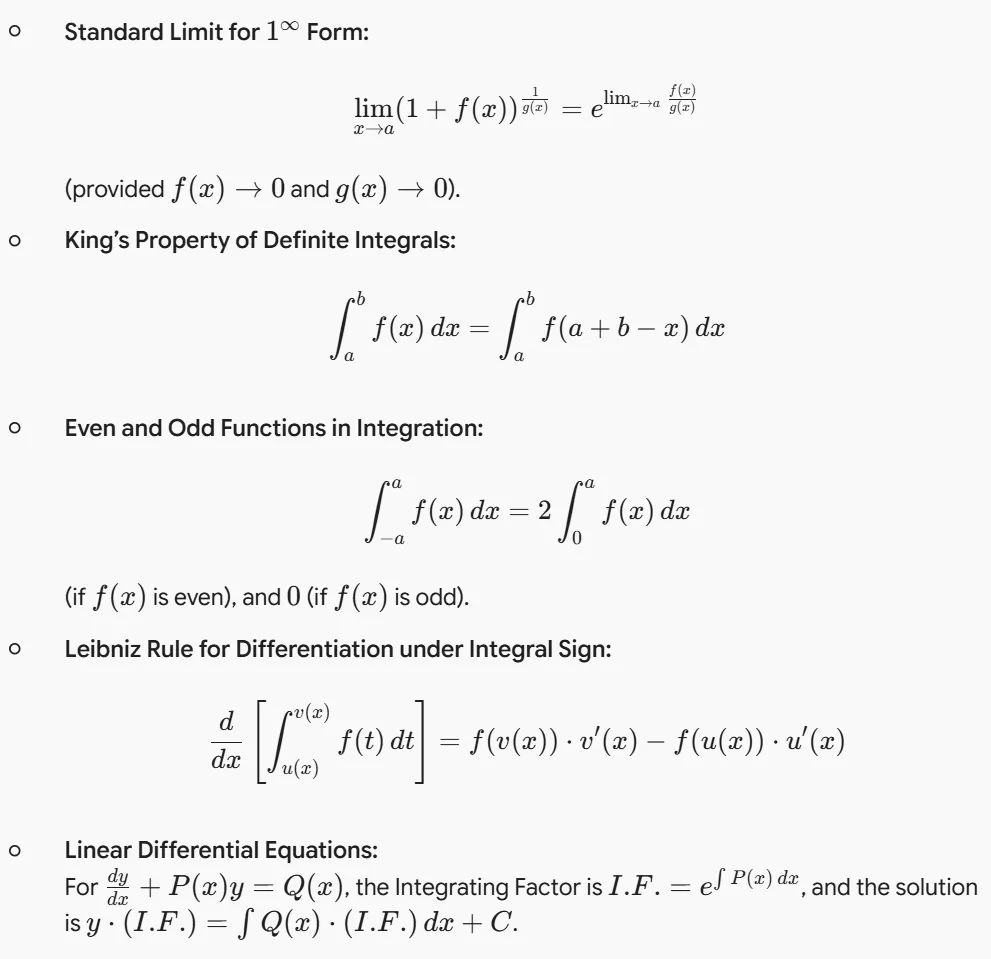
During the 180-minute computer-based test, deriving complex calculus properties from scratch is a severe waste of time. Maintain a dedicated formula sheet and ensure the following relationships are memorized flawlessly:
Tactical Preparation and Execution Strategy
Securing marks in Calculus requires a blend of rigorous mathematical discipline and geometric visualization.
Draw Curves for Area Problems: Never attempt an "Area Under the Curve" problem without drawing a quick rough sketch of the bounding functions. Visualizing the intersection points and which curve lies on top prevents catastrophic setup errors with your definite integrals.
Prioritize Definite over Indefinite Integrals: Indefinite integrals can sometimes lead you down an endless loop of algebraic manipulation. Definite integrals, however, usually rely on applying a specific property (like King's property) to collapse the equation rapidly.
Maintain Calculation Precision in Section B: Calculus numericals frequently involve complex fractions and irrational numbers, especially in Section B. Since Section B features negative marking (every incorrect answer carries a penalty of -1 mark), your arithmetic speed and accuracy must be flawless.
Conclusion
Mastering JEE Main Maths: Calculus is an absolute strategic necessity for crossing the 99th percentile threshold. Because Calculus is the single highest-weightage area in the Mathematics syllabus, it provides an incredible return on your invested study time. Prioritize high-yield chapters like Definite Integration, Application of Derivatives, and Differential Equations. Maintain clean, disciplined calculations to avoid the -1 negative marking penalty in the numerical section, meticulously track your progress, and secure these guaranteed calculus marks to build immense confidence on exam day.