By DekhoCampus Editorial ·
JEE Main Maths: Probability & Statistics Core Guide
Master JEE Main Maths Probability and Statistics. Explore high-weightage topics like Bayes' theorem and variance to maximize your score in 2027.

Preparing for the Joint Entrance Examination (JEE) Main requires candidates to tackle the highly analytical Mathematics section. While calculus and coordinate geometry often consume the majority of a student's preparation time, Probability & Statistics offers a highly reliable path to securing quick marks.
Categorized as a Moderate Priority (P2) segment, Probability & Statistics provides great scoring potential with standard formulas. Because these chapters rely on logical deduction and fixed algebraic expressions rather than endless derivations, mastering them allows you to save crucial time during the 180-minute computer-based test for lengthier topics.
Core Syllabus Breakdown: What You Need to Master
The unit is divided into two distinct halves: Statistics, which is primarily formula-driven, and Probability, which heavily tests your logical comprehension and setup skills.
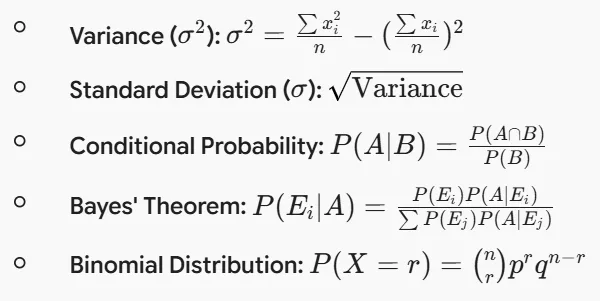
Statistics: This chapter is one of the most straightforward and scoring areas in the entire mathematics syllabus. The National Testing Agency (NTA) consistently tests measures of dispersion. You must be completely fluent in calculating the mean, variance, and standard deviation for both grouped and ungrouped data. Questions often combine statistics with algebraic transformations, where you must quickly calculate the new mean or variance if each observation in a dataset is multiplied or increased by a constant value.
Probability: Probability requires careful reading to avoid logic traps. The most critical and heavily tested concepts revolve around conditional probability and the application of standard formulas, such as Bayes' theorem. Additionally, you must master the Binomial distribution, understanding how to calculate the probability of exactly r successes in n trials, along with calculating the mean and variance of a binomial probability distribution.
Expected Weightage and Focus Areas
As a Moderate Priority (P2) topic in the JEE mathematics syllabus, candidates can reliably expect 2 to 3 questions combined from Probability and Statistics per shift.
Statistics: Usually yields 1 direct question, heavily focused on variance or standard deviation calculations.
Probability: Typically yields 1 to 2 questions, with Bayes' theorem and conditional probability being the absolute favorites for examiners.
Essential Formulas for Instant Recall
During the exam, you cannot afford to derive standard statistical equations from scratch. Keep these core formulas on your rapid-revision sheet:
Tactical Preparation and Tracking
Securing the 8 to 12 marks offered by this unit requires disciplined practice. Statistics questions, specifically, can involve messy decimal calculations. You must practice these numericals without a calculator to simulate the exam environment and avoid the -1 negative marking penalty in Section B.
Conclusion
Mastering JEE Main Maths: Probability & Statistics is a strategic necessity for any candidate looking to cross the 99th percentile. Because this unit holds great scoring potential with standard formulas like Bayes' theorem, it provides an excellent return on your invested study time. Focus heavily on variance properties and conditional probability, practice your decimal calculations diligently, and maintain a strict tracking regimen to confidently clear these questions on exam day.