By DekhoCampus Editorial ·
JEE Main Maths: Algebra Core Strategy & Guide
Master JEE Main Maths Algebra for 2027. Explore core chapters, matrices, complex numbers, and high-yield formulas to secure a top percentile.

For engineering aspirants targeting the Joint Entrance Examination (JEE) Main 2027, the Mathematics section represents the ultimate test of analytical endurance and calculation speed. Within this rigorous section, Algebra stands out as a highly rewarding and standardized domain. In fact, Calculus and Algebra together form more than 60% of the math section.
Unlike differential calculus, which can often twist into abstract graphical scenarios, Algebra relies on fixed algorithms, standard algebraic properties, and predictable expansion patterns. Mastering this block is non-negotiable for securing a top percentile because it provides a reliable source of marks through direct formula application. This comprehensive guide breaks down the core syllabus, high-yield topics like Matrices and Determinants, expected weightage, and the strategic preparation required to dominate Algebra on exam day.
Core Syllabus Breakdown: What You Need to Master
Algebra is a massive chunk of your preparation, encompassing a variety of interconnected chapters. To navigate this unit efficiently, candidates must compartmentalize the syllabus into distinct logical areas.
Matrices and Determinants: This is the most critical and highest-scoring chapter in the entire Algebra module. The National Testing Agency (NTA) categorizes Matrices & Determinants as a High Priority (P1) area. You must thoroughly master the properties of adjoint matrices, inverse matrices, and the evaluation of determinants. Problems involving the consistency of systems of linear equations (using Cramer’s Rule or matrix inversion) are algorithmic and highly scoring, making them practically guaranteed to appear in your shift.
Sequence and Series & Quadratic Equations: Categorized as Moderate Priority (P2) topics, these chapters offer great scoring potential with standard formulas.
Sequence and Series: Focus heavily on Arithmetic Progressions (AP), Geometric Progressions (GP), and Arithmetico-Geometric Progressions (AGP). The sum of infinite series and the application of AM-GM inequalities are frequently tested.
Quadratic Equations: You must be highly fluent in analyzing the nature of roots, the relation between roots and coefficients, and the location of roots relative to a given constant.
Complex Numbers: This chapter is a staple of the JEE Main algebra syllabus. You must understand the representation of complex numbers in polar and Euler forms, modulus and argument properties, and the triangle inequality. The cube roots of unity and De Moivre's Theorem are heavily tested, often requiring geometric interpretation in the Argand plane.
Permutations, Combinations & Binomial Theorem: These chapters require strong logical deduction rather than mere formula application. For Permutations and Combinations (P&C), mastering the fundamental principle of counting, circular permutations, and grouping/distribution is essential. The Binomial Theorem is highly reliable; focus on finding the general term, the term independent of $x$, and the sum of binomial coefficients.
High-Yield Topics and Expected Weightage
To optimize your revision schedule, you must prioritize this unit based on historical question density. While Algebra is vast, certain chapters provide a much better return on invested time.
The table below outlines the core segments and their expected frequency in a standard JEE Main shift, based on standard priority frameworks.
Core Segment | Priority Level | Key Focus Areas for Practice | Expected Questions |
Matrices & Determinants | High Priority (P1) | Adjoint properties, Cramer's rule, systems of linear equations. | 2 - 3 |
Sequence & Series | Moderate Priority (P2) | AP/GP sums, AM-GM inequality, telescoping series. | 1 - 2 |
Quadratic Equations | Moderate Priority (P2) | Nature of roots, common roots, location of roots. | 1 |
Complex Numbers | Moderate Priority (P2) | Polar form, cube roots of unity, Argand plane geometry. | 1 - 2 |
Binomial Theorem & P&C | Moderate Priority (P2) | General term, coefficient extraction, basic counting principles. | 2 |
Candidates can reliably expect 7 to 10 questions from the combined Algebra unit per shift, translating to a massive 28 to 40 marks.
Essential Formulas for Instant Recall
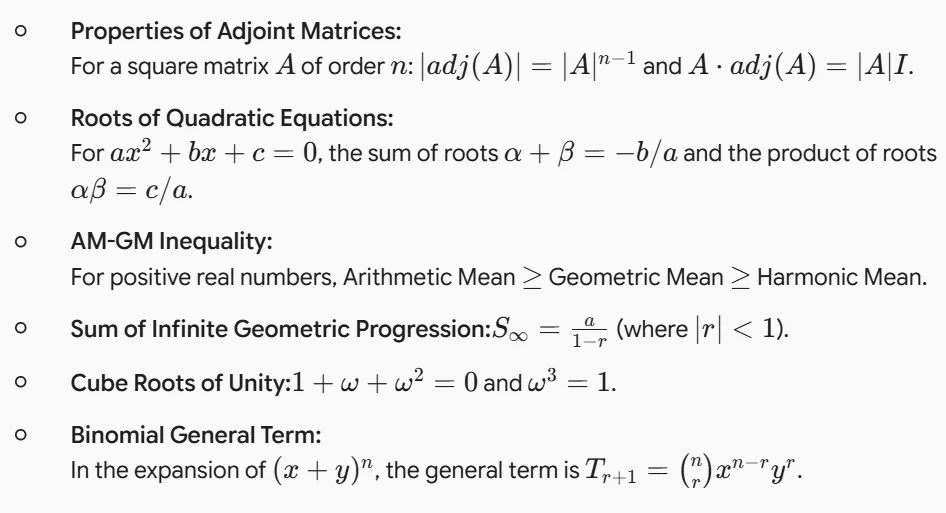
During the 180-minute computer-based test, deriving complex algebraic properties from scratch is a severe waste of time. Maintain a dedicated formula sheet and ensure the following relationships are memorized flawlessly:
Tactical Preparation and Execution Strategy
Securing marks in Algebra requires a blend of rigorous mathematical discipline and strategic problem selection.
Prioritize Matrices and Determinants: Because Matrices and Determinants carry the highest question density within Algebra and are highly algorithmic, you should attempt these questions first. They rarely feature trick scenarios and rely purely on your calculation accuracy.
Beware of P&C Logic Traps: While Permutations and Combinations are part of the core syllabus, questions can sometimes be incredibly complex to interpret. If a P&C problem does not click within the first 60 seconds, mark it for review and move on to standard sequence or binomial questions.
Maintain Calculation Precision: Algebra numericals frequently involve heavy expansions and complex decimal manipulation, especially in Section B. Since Section B carries a strict -1 negative marking penalty for incorrect numerical inputs, your arithmetic speed must be flawless.
Conclusion
Mastering JEE Main Maths: Algebra is an absolute strategic necessity for crossing the 99th percentile threshold. Because this block, alongside Calculus, forms the vast majority of the mathematics paper, it provides an incredible return on your invested study time. Prioritize High Priority (P1) chapters like Matrices and Determinants, lock down standard progression formulas, and rigorously practice coefficient extraction in the Binomial Theorem. Maintain clean, disciplined calculations to avoid negative marking in the numerical section, meticulously track your progress, and secure these guaranteed algebraic marks to build immense confidence on exam day.