By DekhoCampus Editorial ·
JEE Main Chemistry: Electrochemistry Core Topics and Guide
Master JEE Main Chemistry Electrochemistry for 2027. Discover core formulas, high-weightage topics like the Nernst equation, Faraday's laws, and revision strategies.

For aspirants targeting the Joint Entrance Examination (JEE) Main 2027, the Physical Chemistry section is where analytical speed and numerical precision are most heavily tested. Within this domain, Electrochemistry stands out as one of the most critical, high-weightage chapters. It bridges the gap between chemical reactions and electrical energy, seamlessly integrating concepts from thermodynamics and equilibrium.
Because the National Testing Agency (NTA) frequently places Electrochemistry problems in the calculation-heavy Section B (Numerical Value Questions), having a superficial understanding of the theory is not enough. You must be able to recall standard formulas instantly and execute decimal calculations flawlessly to avoid the -1 negative marking penalty. This comprehensive guide breaks down the core topics, essential formulas, and the exact preparation strategy required to dominate Electrochemistry in JEE Main.
Core Syllabus Breakdown: What to Master
Electrochemistry is vast, but the questions asked in JEE Main are highly predictable. The chapter can be broadly divided into three distinct segments, each requiring a unique problem-solving approach.
Electrochemical Cells and the Nernst Equation: This is the most heavily tested segment of the chapter. You must understand how galvanic (voltaic) cells operate, including the function of the salt bridge and standard hydrogen electrodes. You can consistently expect questions based on the Nernst equation and cell electromotive force (EMF). You must be able to calculate the EMF of a cell at non-standard conditions and relate the standard cell potential to the equilibrium constant and standard Gibbs free energy.
Electrolysis and Faraday's Laws: This segment shifts focus to electrolytic cells, where electrical energy drives non-spontaneous chemical reactions. You can expect questions based on Faraday’s laws of electrolysis. You must master both the First Law (calculating the mass of a substance deposited at an electrode given current and time) and the Second Law (relating deposited masses to their equivalent weights).
Conductance in Electrolytic Solutions: The final segment deals with the resistance and conductance of electrolytic solutions. You must thoroughly understand and expect questions based on molar conductivity. The variation of conductivity and molar conductivity with concentration for both strong and weak electrolytes is a frequent theoretical testing area. Kohlrausch’s Law of Independent Migration of Ions is an absolute must-cover topic, specifically for calculating the limiting molar conductivity of weak electrolytes.
High-Yield Topics and Expected Weightage
To optimize your study hours, you must prioritize the sections that historically yield the most marks. In Physical Chemistry, Electrochemistry frequently features direct computational questions.
Based on past exam trends, candidates can reliably expect 1 to 2 questions from Electrochemistry per shift. These questions are almost always numerically driven, meaning rote memorization of textbook paragraphs will not help you here. Your focus must be on numerical application.
Essential Formulas to Keep on Standby
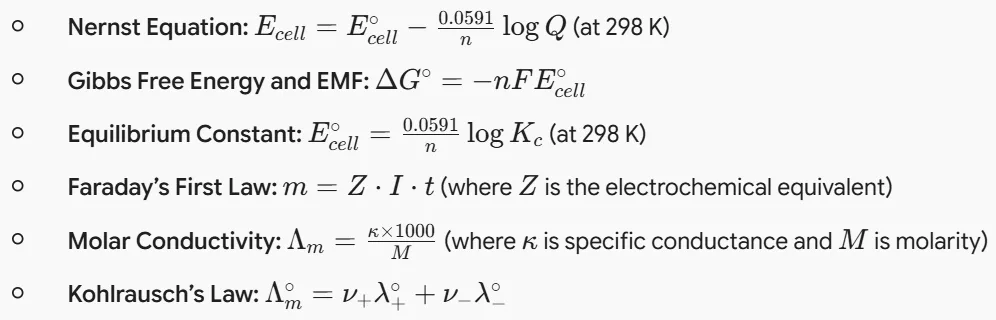
During the 180-minute computer-based test, you cannot afford to derive relationships from scratch. Maintain a dedicated formula sheet for Physical Chemistry and ensure the following Electrochemistry formulas are memorized:
Strategic Preparation and Tracking
To secure the 4 to 8 marks offered by this unit, your preparation must be highly disciplined and focused on eliminating calculation errors.
Master Logarithms: The Nernst equation heavily relies on logarithmic calculations. Ensure you are fluent in basic log properties and have the values memorized.
Mind Your Units: Electrochemistry numericals will frequently mix units (e.g., standard electrode potentials in Volts, current in Amperes, time in minutes instead of seconds). Always convert time to seconds before applying Faraday's laws.
Conclusion
Mastering JEE Main Chemistry: Electrochemistry is a vital step toward securing a top percentile in the Physical Chemistry section. Because this chapter frequently features direct computational questions, it heavily rewards students who possess strong formula recall and accurate decimal calculation skills. By prioritizing the Nernst equation, Faraday's laws, and molar conductivity, and by maintaining a rigorous tracking system for your mock tests, you can quickly navigate these numerical challenges and bank crucial marks for your overall score.