By DekhoCampus Editorial ·
JEE Main Chemistry: Chemical Thermodynamics and Energetics Guide
A comprehensive preparation guide focusing on the Chemical Thermodynamics and Energetics unit for the JEE Main Chemistry paper. Explore high-weightage topics like Hess's Law, Gibbs free energy, and the First Law of Thermodynamics, and disco

When preparing for the Joint Entrance Examination (JEE) Main, the Physical Chemistry section acts as a crucial battleground where calculation speed meets conceptual clarity. Among its many chapters, Chemical Thermodynamics and Energetics stands as an absolute foundational pillar. This unit frequently yields 1 to 2 direct questions per shift and is essential because its core principles overlap heavily with the Heat and Thermodynamics unit in the Physics syllabus.
Mastering this chapter provides a massive strategic advantage, allowing candidates to secure marks efficiently across both subjects. This comprehensive guide breaks down the core topics, essential formulas, sign convention traps, and the optimal revision strategy to conquer Chemical Thermodynamics in JEE Main 2027.
Core Syllabus Breakdown: What to Master
Chemical Thermodynamics dictates the feasibility, direction, and energy changes of chemical reactions. To succeed, candidates must break the chapter into distinct, manageable segments.
The First Law and Basic Concepts: Begin with the definitions of system, surroundings, and state functions (internal energy, enthalpy, entropy) versus path functions (work, heat). The First Law of Thermodynamics (Conservation of Energy) is the mathematical core of this segment. You must be able to calculate work done during isothermal and adiabatic reversible and irreversible expansion/compression of ideal gases.
Thermochemistry and Enthalpy: This segment deals directly with chemical reactions. Focus heavily on Hess’s Law of Constant Heat Summation. The National Testing Agency (NTA) frequently tests your ability to manipulate multiple reaction equations to find the standard enthalpy of a target reaction. Ensure you understand the nuances between enthalpy of formation, combustion, neutralization, and bond dissociation enthalpy.
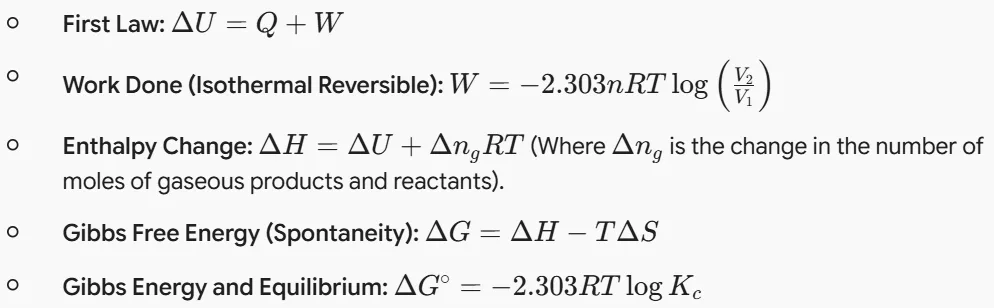
Second and Third Laws (Spontaneity): The Second Law introduces entropy, the measure of randomness. However, the most critical concept here is Gibbs Free Energy. The equation is guaranteed to appear in some form. The relationship between standard Gibbs free energy and the equilibrium constant is another high-yield testing area.
The Danger of Sign Conventions
The most frequent error students make in this chapter is confusing the sign conventions between Chemistry and Physics.
Work Done: In Chemistry, work done on the system (compression) is positive, because it increases the internal energy of the system. Work done by the system (expansion) is negative.
Heat: Heat absorbed by the system (endothermic) is positive. Heat released by the system (exothermic) is negative.
Always double-check which section of the paper you are attempting before writing down the First Law equation.
Essential Formulas to Keep on Standby
For Section B (Numerical Value Questions), having formulas instantly accessible is mandatory. Keep these core relationships on a dedicated revision sheet:
Strategic Preparation and Tracking
To secure marks in Chemical Thermodynamics, rote memorization is insufficient.
Practice Hess's Law Puzzles: Treat Hess's Law questions like algebraic puzzles. Practice aligning and multiplying reaction equations rapidly.
Units Matter: Pay strict attention to units, specifically ensuring that equations are converted to the same base unit before calculating Gibbs free energy.
Conclusion
Chemical Thermodynamics and Energetics is a high-yield, conceptually dense chapter that serves as the bedrock for Physical Chemistry. By mastering the core principles of enthalpy, Hess's Law, and Gibbs free energy, candidates can navigate the numerical challenges of Section B with confidence. Remember to rigidly enforce the correct sign conventions, meticulously track your calculation errors, and practice standard formula applications to secure these crucial marks in the JEE Main examination.