By DekhoCampus Editorial ·
JEE Main Chemistry: Chemical and Ionic Equilibrium Guide
Master Chemical and Ionic Equilibrium for JEE Main 2027. Discover high-weightage topics, essential pH formulas, Le Chatelier's principle, and calculation strategies.

For engineering aspirants preparing for the Joint Entrance Examination (JEE) Main, the Physical Chemistry section acts as a rigorous test of both conceptual clarity and mathematical speed. It requires students to balance theory with direct numerical application. Within this critical segment, the Equilibrium unit-comprising both Chemical and Ionic Equilibrium-stands out as one of the most foundational and frequently tested chapters.
Because the National Testing Agency (NTA) heavily favors placing physical chemistry calculation problems in Section B (Numerical Value Questions), a superficial understanding of the theory is entirely insufficient. Candidates must master Chemical and Ionic Equilibrium, which frequently feature direct computational questions. This comprehensive guide breaks down the core syllabus, essential formulas, high-yield topics like Le Chatelier's principle and pH calculations, and the exact preparation strategy required to dominate Equilibrium in the JEE Main examination.
Core Syllabus Breakdown: What You Need to Master
The Equilibrium chapter is vast and heavily analytical. The questions asked in JEE Main revolve around two distinct pillars, each requiring a specific problem-solving approach and mathematical mindset.
Chemical Equilibrium: This segment forms the theoretical and mathematical basis for reversible reactions. You must thoroughly understand the law of mass action and the dynamic nature of equilibrium. The most heavily tested concepts here are the equilibrium constants in terms of concentration and partial pressure. You must be completely fluent in calculating the reaction quotient to predict the direction of a reaction. Furthermore, Le Chatelier's principle is an absolute favorite for theoretical Multiple Choice Questions (MCQs) in Section A. You must instantly recognize how changes in temperature, pressure, concentration, or the addition of an inert gas at constant volume/pressure will shift the equilibrium state.
Ionic Equilibrium: Often considered the more challenging half of the chapter, Ionic Equilibrium requires rigorous decimal calculations and a deep understanding of approximations. This section deals with the equilibrium of ionic species in aqueous solutions. The syllabus is dense, covering Arrhenius, Brønsted-Lowry, and Lewis concepts of acids and bases. You must master pH calculations for strong and weak acids/bases, and understand the common ion effect. Furthermore, buffer solutions and salt hydrolysis form a massive chunk of the numerical questions. Finally, the concept of solubility products and predicting ionic precipitation is guaranteed to appear in standard exam shifts.
High-Yield Topics and Expected Weightage
To optimize your study schedule, you must prioritize the sections that historically yield the most marks. In Physical Chemistry, mastering Equilibrium is non-negotiable as it provides a reliable source of marks and connects deeply with Electrochemistry and Thermodynamics.
Based on historical exam trends, candidates can reliably expect 1 to 2 questions from the Equilibrium unit per shift. These questions frequently populate the numerical section, requiring high accuracy.
Core Segment | Key Focus Areas for Practice | Expected Questions |
Ionic Equilibrium (Buffers & pH) | pH calculations of mixtures, Henderson-Hasselbalch equation for buffer solutions, salt hydrolysis. | 1 |
Ionic Equilibrium (Solubility) | Solubility product , common ion effect on solubility, ionic product. | 0 - 1 |
Chemical Equilibrium | Degree of dissociation, Le Chatelier's principle. | 1 |
Essential Formulas for Instant Recall
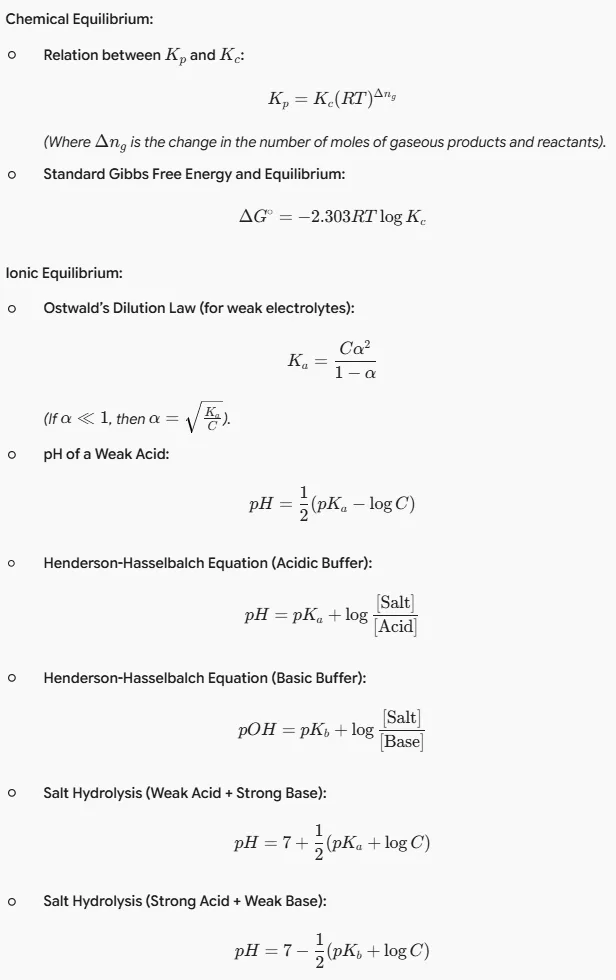
During the 180-minute computer-based test, deriving critical relationships from scratch will cost you precious time. Maintain a dedicated formula sheet and ensure the following Equilibrium formulas are memorized flawlessly:
Tactical Preparation and Execution Strategy
To secure the 4 to 8 marks offered by this unit, your preparation must be heavily disciplined and focused on eliminating basic calculation errors, particularly with logarithms and quadratic equations.
Master Approximations: In Ionic Equilibrium, knowing when to ignore the degree of dissociation with respect to 1 is critical.
Logarithmic Agility: pH calculations and standard free energy equations rely entirely on logarithmic arithmetic.
Accuracy in Section B: Because Section B (Numerical Value Questions) features a -1 negative marking penalty, you must ensure your calculation speed is flawless to avoid silly decimal errors when inputting pH values or equilibrium constants.
Conclusion
Mastering JEE Main Chemistry: Equilibrium is a mandatory step toward securing a top percentile in the Physical Chemistry section. Because this chapter tests a blend of theoretical deduction (like Le Chatelier's principle) and intense algebraic calculations (like buffer pH and solubility products), it heavily rewards disciplined practice. Focus your energy on understanding the common ion effect, mastering the Henderson-Hasselbalch equation, and executing clean logarithmic calculations. By systematically tracking your mock test errors and avoiding approximation traps, you will confidently clear these high-yield questions on exam day.