By Rohan Patel ·
CBSE Class 12 Chemistry Formula Sheet 2027: All Chapters, Reactions & Quick Revision Notes
Revise important Class 12 Chemistry formulas, numerical equations, organic reactions and key concepts with this quick-reference guide for the CBSE 2027 board examination.

The CBSE Class 12 Chemistry Formula Sheet 2027 is a useful revision resource for students preparing for the board examination. Chemistry requires students to remember formulas, understand chemical reactions and apply concepts while solving numerical questions. Revising these topics together can save time during the final days of preparation.
This guide covers important formulas from Physical Chemistry, selected reactions from Organic Chemistry and key concepts from Inorganic Chemistry. Students should use it alongside their NCERT textbooks and the official CBSE 2026-27 syllabus. The list is a quick revision aid, not a replacement for complete syllabus preparation.
Solutions: Important Chemistry Formulas
Solutions includes concentration terms and colligative properties. Students should understand the meaning of each variable before substituting values in numerical questions.
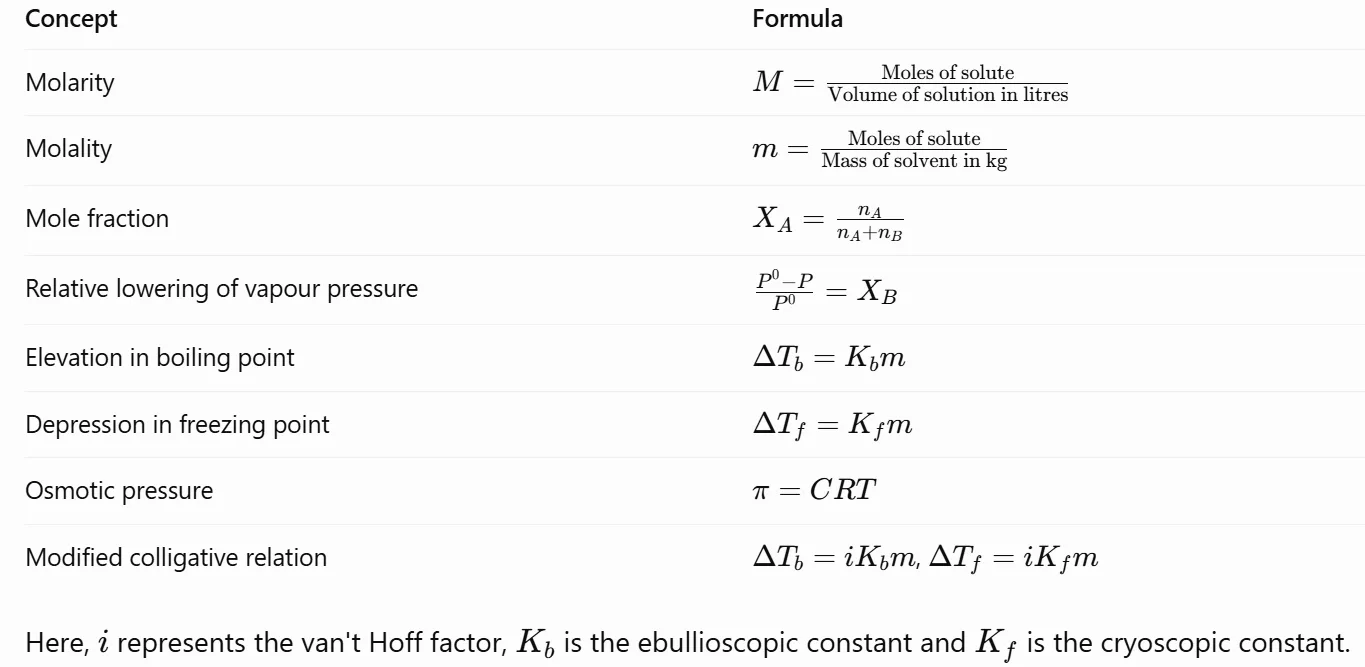
Revision tip: Practise questions involving molar mass determination, osmotic pressure and abnormal molar mass. Always convert temperature and volume units where required.
Electrochemistry: Important Formulas
Electrochemistry includes cell potential, electrical conductivity and the relationship between Gibbs energy and EMF.
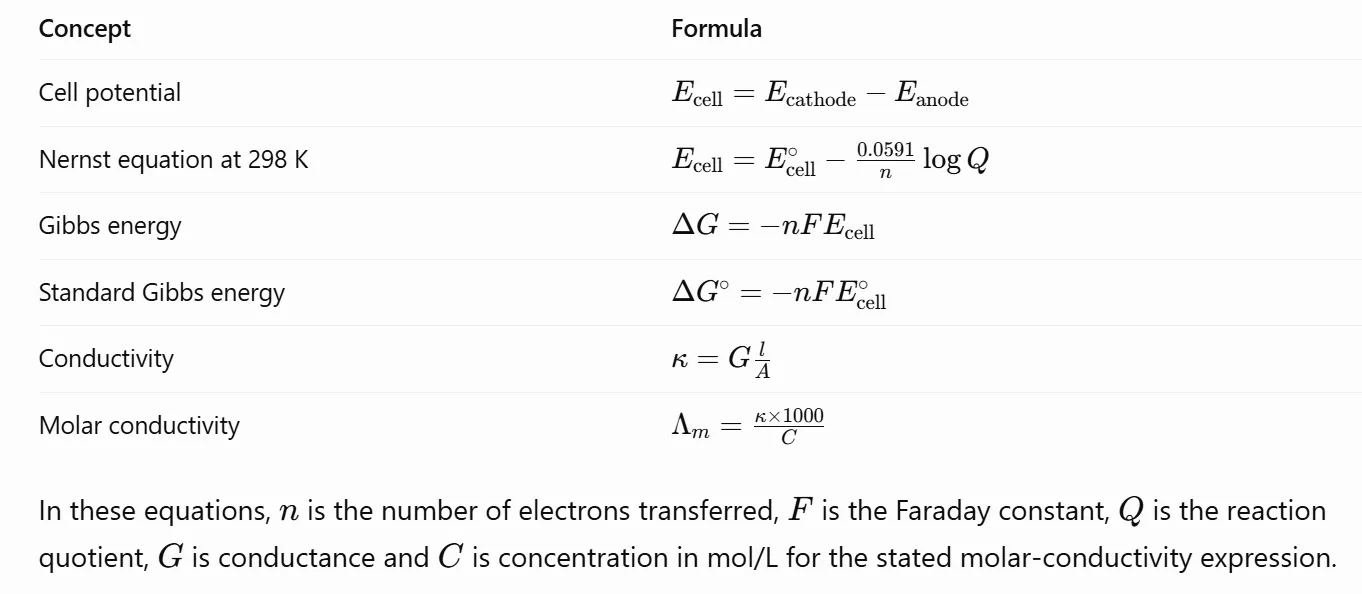
Revision tip: Practise cell representation, oxidation and reduction reactions, Nernst equation problems and conductivity calculations.
Chemical Kinetics: Important Formulas
Chemical Kinetics deals with reaction rates and the factors affecting them. Students should remember the integrated rate equations and half-life expressions.
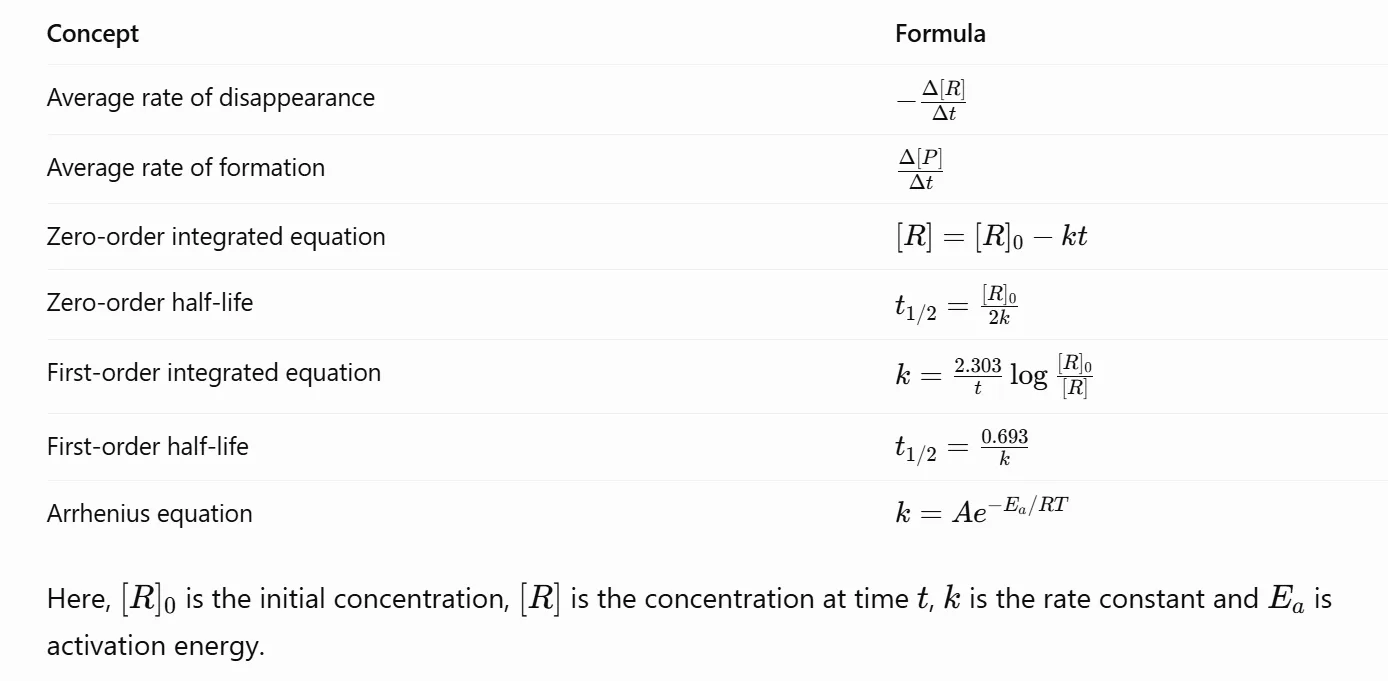
Revision tip: Do not confuse zero-order and first-order reactions. Their integrated equations and half-life expressions are different.
Organic Chemistry: Important Reactions to Revise
Organic Chemistry requires students to understand how functional groups behave under different reaction conditions. Instead of memorising isolated equations, prepare a reaction chart that connects reactants, reagents and products.
Haloalkanes and Haloarenes
Revise the following reaction types:
Nucleophilic substitution reactions: SN1 and SN2.
Hydrolysis of haloalkanes to form alcohols.
Dehydrohalogenation to form alkenes.
Wurtz reaction for the preparation of higher alkanes.
Finkelstein and Swarts reactions.
Alcohols, Phenols and Ethers
Important reactions include:
Oxidation of primary and secondary alcohols.
Dehydration of alcohols to form alkenes.
Reaction of alcohols with sodium.
Bromination of phenol.
Kolbe's reaction.
Reimer-Tiemann reaction.
Williamson ether synthesis.
Aldehydes, Ketones and Carboxylic Acids
Students should revise:
Oxidation and reduction reactions of aldehydes and ketones.
Tollens' test and Fehling's test.
Aldol condensation.
Cannizzaro reaction.
Nucleophilic addition reactions.
Esterification of carboxylic acids.
Decarboxylation reactions.
Amines
Important reactions and concepts include:
Preparation of amines by reduction of nitro compounds.
Gabriel phthalimide synthesis.
Hoffmann bromamide degradation.
Carbylamine reaction.
Diazotisation of primary aromatic amines.
Coupling reactions of diazonium salts.
Students should learn the correct reagents, reaction conditions and products for each transformation. Writing a reaction without the required conditions may result in an incomplete answer.
Inorganic Chemistry: Key Concepts for Quick Revision
Inorganic Chemistry involves periodic trends, electronic configurations, oxidation states and coordination chemistry. Students should revise the explanations behind these properties rather than learning only definitions.
d- and f-Block Elements
Revise the following:
General electronic configuration of transition elements.
Variable oxidation states.
Formation of coloured ions.
Magnetic properties and unpaired electrons.
Catalytic behaviour of transition metals.
Lanthanoid contraction and its consequences.
Comparison of lanthanoids and actinoids.
Coordination Compounds
Important concepts include:
Coordination number and coordination entity.
Ligands and denticity.
Oxidation state of the central metal ion.
IUPAC nomenclature.
Geometrical and optical isomerism.
Valence Bond Theory.
Crystal Field Theory and splitting of d-orbitals.
Revision tip: Practise naming coordination compounds and identifying the oxidation state, coordination number and type of isomerism. These questions require careful application of rules.
Biomolecules: Definitions and Concepts
Biomolecules is a concept-based chapter. Students should prepare short notes covering classifications, structures and biological functions.
Topic | What to revise |
|---|---|
Carbohydrates | Monosaccharides, disaccharides and polysaccharides |
Proteins | Amino acids, peptide bonds and protein structures |
Enzymes | Biological catalysts and their functions |
Vitamins | Classification and deficiency-related information |
Nucleic acids | DNA, RNA and their differences |
Students should pay attention to reducing and non-reducing sugars, denaturation of proteins and the structural differences between DNA and RNA.
How to Use the Chemistry Formula Sheet Before the Board Exam
A formula sheet is most useful when students actively apply it instead of reading it repeatedly. Follow a simple revision routine:
Start with Physical Chemistry: Write all formulas from memory and solve at least a few numerical questions from each prescribed chapter.
Prepare an Organic Chemistry reaction chart: Group reactions by functional group and mention reagents and conditions.
Revise Inorganic Chemistry concepts: Review definitions, oxidation states, electronic configurations and coordination compound nomenclature.
Practise NCERT questions: Use textbook examples and exercises to test your understanding.
Attempt the sample paper: Solve the official 2026-27 Chemistry sample paper under timed conditions.
Review mistakes: Keep a separate list of formulas, reactions and concepts that you repeatedly get wrong.
The official CBSE sample paper and marking scheme are available on the CBSE Class XII 2026-27 page.
Common Mistakes to Avoid in the Chemistry Board Exam
Students can lose marks even when they understand a concept if they do not present the answer carefully.
Writing an incorrect unit in numerical answers.
Using the wrong logarithmic expression in a kinetics problem.
Forgetting the reaction conditions or reagents in organic conversions.
Confusing oxidation and reduction at the anode and cathode.
Writing an incorrect oxidation state in coordination compounds.
Leaving numerical answers without calculation steps.
Ignoring chemical equations while explaining reactions.
Check the final answer, units, significant figures and chemical equations before moving to the next question.
Conclusion
The CBSE Class 12 Chemistry Formula Sheet 2027 can make last-minute revision more organised by bringing together important equations, reactions and concepts. Students should use it to test their recall and practise questions from the prescribed syllabus. Regular numerical practice, NCERT revision and sample-paper solving are equally important for performing well in the board examination.