By DekhoCampus Editorial ·
JEE Main Chemistry: Chemical Kinetics Core Topics and Guide
A comprehensive preparation guide focusing on the Chemical Kinetics unit for the JEE Main Chemistry paper. Explore high-yield topics like first-order rate laws, activation energy, and graphical analysis, along with actionable strategies to

For engineering aspirants preparing for the Joint Entrance Examination (JEE) Main, the Physical Chemistry section acts as a rigorous test of both conceptual clarity and mathematical speed. Within this critical segment, Chemical Kinetics stands out as a foundational, high-weightage chapter that frequently yields direct computational questions. Unlike abstract theoretical topics, Chemical Kinetics bridges the gap between chemical reactions and time, focusing on how fast reactions occur and the specific factors that influence their rates.
Because the National Testing Agency (NTA) heavily favors placing these calculation-dense problems in Section B (Numerical Value Questions), a superficial understanding of the theory is entirely insufficient. Candidates must master rate laws and Arrhenius equations to secure a top percentile. This comprehensive guide breaks down the core syllabus, essential formulas, graphical interpretations, and the exact preparation strategy required to dominate Chemical Kinetics in the JEE Main examination.
Core Syllabus Breakdown: What You Need to Master
Chemical Kinetics is highly logical and mathematically predictable. The questions asked in JEE Main revolve around three distinct pillars, each requiring a specific problem-solving approach.
Rate of Reaction and Rate Laws: This introductory segment forms the basis of the chapter. You must understand the difference between the average rate and the instantaneous rate of a reaction. The most heavily tested concept here is the Rate Law expression, which dictates how the rate depends on reactant concentrations. You must be completely fluent in defining and distinguishing between the Order (an experimentally determined value) and the Molecularity (a theoretical concept) of a reaction.
Integrated Rate Equations (Zero and First Order): This is the absolute core of the chapter. While the syllabus technically covers zero, first, and second-order reactions, the vast majority of JEE Main questions strictly target First-Order kinetics. You must master the integrated rate equation for first-order reactions and thoroughly understand the concept of Half-Life. Additionally, Pseudo-First-Order reactions (like the hydrolysis of ester or inversion of cane sugar) are highly favored by examiners.
Collision Theory and the Arrhenius Equation: This final segment connects reaction rates with temperature and activation energy. The Arrhenius equation is guaranteed to appear in standard exam shifts. You must understand the concept of Activation Energy, the effect of a catalyst on the activation energy profile, and how to calculate the rate constant at two different temperatures. Graphical questions plotting are extremely common and require sharp coordinate geometry skills to interpret the slope and intercept.
High-Yield Topics and Expected Weightage
To optimize your study schedule, you must prioritize the sections that historically yield the most marks. In Physical Chemistry, mastering Chemical Kinetics is non-negotiable as it provides a reliable source of marks.
Based on historical exam trends, candidates can reliably expect 1 to 2 questions from Chemical Kinetics per shift. Because you must rigorously practice the numerical aspects of Electrochemistry and Kinetics, you should prepare for these to frequently populate Section B of the exam.
Core Segment | Key Focus Areas for Practice | Expected Questions |
Integrated Rate Laws | First-order rate constant calculations, half-life, pseudo-first-order reactions. | 1 |
Arrhenius Equation | Activation energy, temperature coefficient, graphs. | 1 |
Rate of Reaction | Order vs. Molecularity, initial rate method to determine reaction order. | 0 - 1 |
Essential Formulas and Graphs to Keep on Standby
During the 180-minute computer-based test, you cannot afford to derive these critical relationships from scratch. Maintain a dedicated formula sheet and ensure the following Chemical Kinetics formulas are memorized flawlessly:
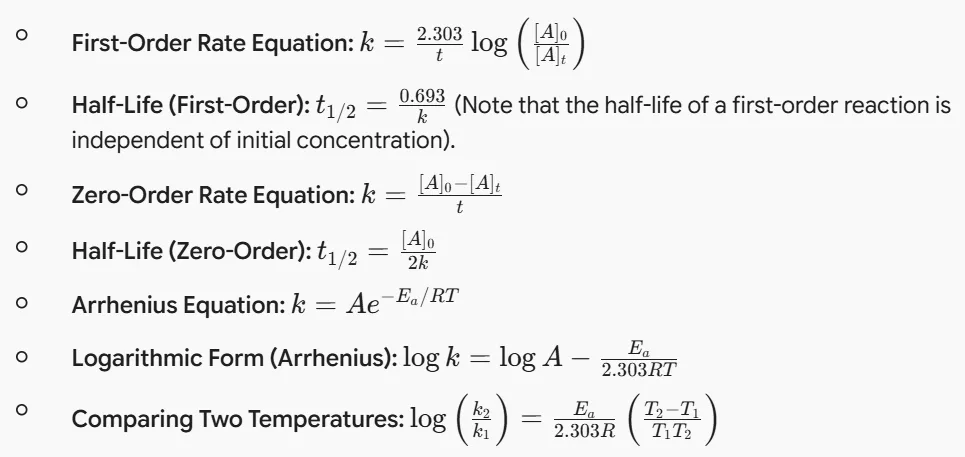
Mastering the Graphs: Chemical Kinetics is highly visual. You must immediately recognize the shapes of concentration vs. time graphs for zero and first-order reactions.
Strategic Preparation and Progress Tracking
To secure the 4 to 8 marks offered by this unit, your preparation must be heavily disciplined and focused on eliminating basic calculation errors.
Master Logarithmic Arithmetic: The Arrhenius and first-order rate equations rely heavily on logarithmic calculations. Ensure you are fluent in basic log properties and have the values memorized.
Ensure Calculation Speed and Decimal Accuracy: You must ensure your calculation speed is flawless to avoid silly decimal errors, especially since these questions frequently populate the negative-marked Section B.
Link with Modern Physics: The mathematics of first-order kinetics is completely identical to the mathematics of Radioactive Decay in the Modern Physics syllabus. Studying the half-life and decay constant formulas here gives you an immediate advantage in Physics.
Conclusion
Mastering JEE Main Chemistry: Chemical Kinetics is an essential strategy for crossing the 99th percentile threshold in the Physical Chemistry section. Because this chapter relies heavily on direct formula application and features standard mathematical logarithms, it offers an incredible return on your invested study time. Focus your energy heavily on first-order integrated rate laws, the Arrhenius equation, and graphical interpretations. Maintain clean calculations to avoid the negative marking penalty in Section B, meticulously track your progress, and secure these guaranteed marks to build immense confidence on exam day.