By DekhoCampus Editorial ·
JEE Main Maths: Vectors & 3D Geometry Core Strategy & Guide
A comprehensive preparation guide focusing on the Vectors and 3D Geometry unit for the JEE Main Mathematics paper. Explore high-yield topics like scalar triple products, skew lines, and plane equations, along with actionable strategies to s

For engineering aspirants targeting the Joint Entrance Examination (JEE) Main 2027, the Mathematics section often poses the greatest challenge due to its lengthy, calculation-dense problems. However, within this grueling section lies a highly predictable and heavily rewarding goldmine: Vectors and 3D Geometry.
Unlike differential calculus or probability, which can twist into highly abstract scenarios, Vectors and 3D Geometry rely on fixed spatial rules, standard algorithmic formulas, and visual logic. Because the National Testing Agency (NTA) frequently tests this unit across both Section A (Multiple Choice) and Section B (Numerical Value Questions), mastering it is a non-negotiable requirement for securing a 99+ percentile. This comprehensive guide breaks down the core syllabus, high-yield formulas, expected weightage, and the exact strategic preparation required to dominate Vectors and 3D Geometry in the upcoming exam.
Core Syllabus Breakdown: What You Need to Master
To navigate this unit efficiently, candidates must understand that Vectors and 3D Geometry are not two separate chapters; they are the exact same concepts expressed in different mathematical languages. Mastering vector algebra is the mandatory first step before tackling three-dimensional space.
Vector Algebra: This foundational segment requires you to visualize magnitude and direction. You must thoroughly master the addition of vectors, scalar (dot) products, and vector (cross) products. However, the JEE Main questions heavily target the advanced portions: the Scalar Triple Product (Box Product) and the Vector Triple Product. You must be able to use the box product to determine the volume of a parallelepiped and establish the coplanarity of vectors.
Three-Dimensional Geometry: This chapter translates vector logic into Cartesian coordinates. You must understand direction cosines and direction ratios perfectly, as they form the backbone of every line and plane equation.
Lines in Space: Focus on the equations of a line in both vector and Cartesian forms, finding the angle between two lines, and calculating the perpendicular distance of a point from a line. The absolute highest-yield topic here is finding the shortest distance between two skew lines.
Planes: The NTA has historically loved questions involving planes. You must master the equation of a plane in normal form, intercept form, and passing through three non-collinear points. Problems involving the intersection of a line and a plane, the angle between two planes, and the family of planes (a plane passing through the intersection of two other planes) are practically guaranteed to appear.
High-Yield Topics and Expected Weightage
To optimize your revision schedule, you must prioritize this unit heavily. Vectors and 3D Geometry belong to the "High Priority (P1)" tier of the JEE Main Mathematics syllabus. It offers one of the best returns on invested study time because the questions are highly standardized.
Based on historical exam trends, candidates can reliably expect 3 to 4 questions from this combined unit per shift, translating to a massive 12 to 16 marks.
Core Segment | Key Focus Areas for Practice | Expected Questions |
3D Geometry (Lines & Planes) | Shortest distance between skew lines, intersection of planes, image of a point in a plane. | 2 |
Vector Algebra | Scalar triple product (coplanarity), vector triple product, dot/cross product properties. | 1 - 2 |
Combined Mixed Concepts | Finding the line of intersection of two planes using cross products. | 0 - 1 |
Essential Formulas for Instant Recall
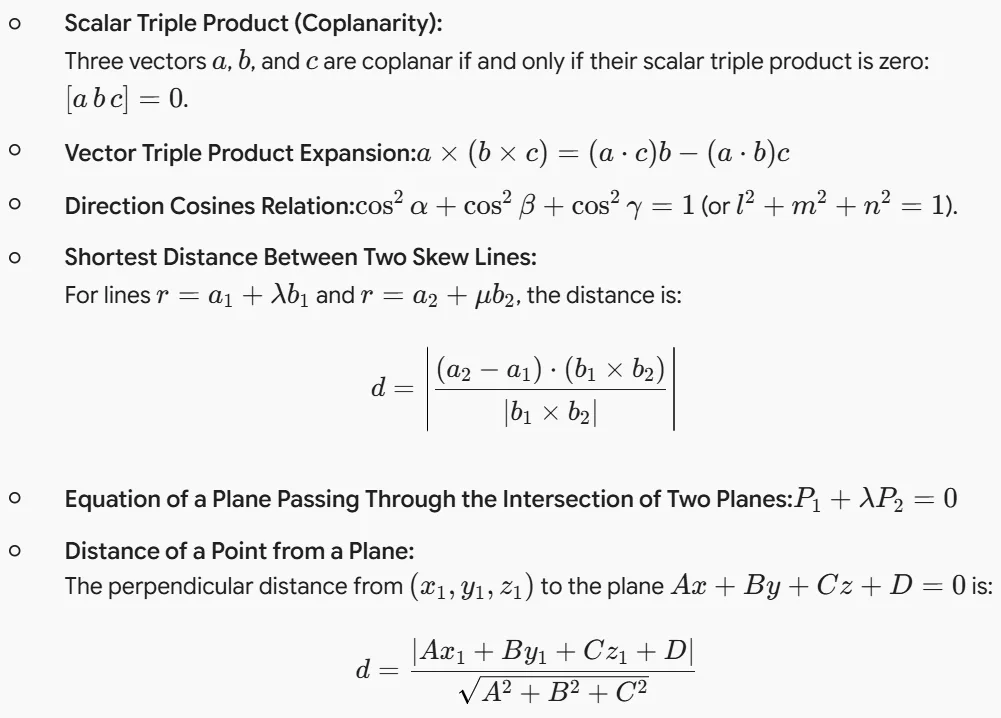
During the 180-minute computer-based test, you cannot afford to derive complex 3D formulas from scratch. Maintain a dedicated formula sheet and ensure the following relationships are memorized flawlessly:
Tactical Preparation and Execution Strategy
Securing marks in Vectors and 3D Geometry requires a blend of spatial visualization and rigorous algebraic discipline.
Draw Rough Spatial Diagrams: Never attempt a 3D Geometry problem (like finding the foot of the perpendicular or the image of a point) without drawing a quick, rough 3D sketch on your scratchpad. Visualizing the setup prevents catastrophic sign errors.
Master Cross-Conversions: You must be able to seamlessly convert line and plane equations from Vector form to Cartesian form and vice versa. Sometimes, solving a Cartesian plane problem is much faster if you temporarily convert it into a vector dot-product equation.
Beware of Section B Negative Marking: These questions frequently populate the Numerical Value portion of the exam. Ensure your calculation speed is flawless to avoid silly decimal or sign errors, as Section B carries a strict -1 negative marking penalty.
Conclusion
Mastering JEE Main Maths: Vectors and 3D Geometry is an absolute strategic necessity for crossing the 99th percentile threshold. Because this block relies heavily on standard algorithms rather than abstract proofs, it provides an incredible return on your invested study time. Focus your energy heavily on the shortest distance between skew lines, the scalar triple product, and plane intersection properties. Maintain clean, disciplined calculations to avoid negative marking, meticulously track your progress, and secure these guaranteed 12 to 16 marks to build immense confidence on exam day.