By DekhoCampus Editorial ·
JEE Main Maths Coordinate Geometry: Core Strategy & Guide
A comprehensive preparation guide focusing on the Coordinate Geometry unit for the JEE Main Mathematics paper. Explore high-yield topics like conic sections, straight lines, circles, and standard tangent equations, along with actionable str

For engineering aspirants targeting the Joint Entrance Examination (JEE) Main 2027, the Mathematics section is often the most time-consuming and analytically demanding segment of the paper. However, within this rigorous section lies a highly standardized and rewarding domain: Coordinate Geometry.
Unlike abstract calculus problems that may require obscure substitutions, Coordinate Geometry relies on fixed geometric principles, standard algebraic equations, and visual locus plotting. Conic Sections (Parabola, Ellipse, Hyperbola) form a predictable high-return block within the mathematics syllabus. Because the National Testing Agency (NTA) consistently tests these concepts heavily in both the multiple-choice and numerical value sections, mastering this unit is non-negotiable for securing a top percentile. This comprehensive guide breaks down the core syllabus, high-yield formulas, expected weightage, and the strategic preparation required to dominate Coordinate Geometry.
Core Syllabus Breakdown: What You Need to Master
Coordinate geometry requires absolute precision and spans a wide variety of interconnected shapes and systems. The syllabus is broadly divided into four progressive segments, each building algebraically upon the last.
Cartesian System and Straight Lines: This is the foundational bedrock of the unit. Coordinate geometry spans the Cartesian system, distance formulas, section formulas, locus, and shift of origin. You must be highly fluent in translating geometric conditions into algebraic equations. The study of straight lines includes slope, various forms of equations, the angle between lines, and concurrent lines. Mastering the calculation of the perpendicular distance of a point from a line and the equations of angle bisectors will save you critical minutes on exam day.
Circles: The circle is heavily tested, both as an independent concept and in combination with straight lines and other conics. The syllabus for circles covers standard and general equations, parametric forms, tangents, normals, intersecting circles, and common chords. The concept of the radical axis, the family of circles (circles passing through the intersection of a line and a circle, or two circles), and orthogonality conditions are frequent testing favorites.
Conic Sections (Parabola, Ellipse, Hyperbola): This segment is heavily formula-driven and highly analytical, focusing on standard equations, focus, directrix, eccentricity, tangents, and normal properties.
Parabola: You must master the standard forms, focal chords, and the parametric coordinates. Tangent and normal equations in slope form are practically guaranteed to appear.
Ellipse & Hyperbola: These two shapes are mathematically linked by their eccentricity values. You must memorize the standard equations, the length of the latus rectum, auxiliary circles, and director circles. Understanding the conjugate hyperbola and asymptotes will also provide a significant edge.
High-Yield Topics and Expected Weightage
To optimize your revision schedule, you must prioritize this unit heavily. Coordinate Geometry typically accounts for 15% to 20% of the entire mathematics paper, making it one of the largest standalone blocks outside of Calculus.
The table below outlines the core segments and their expected frequency in a standard JEE Main shift.
Core Segment | Key Focus Areas for Practice | Expected Questions |
Conic Sections (Parabola, Ellipse, Hyperbola) | Focus, directrix, eccentricity, tangents, and normal properties. | 2 - 3 |
Circles | Parametric forms, tangents, intersecting circles, common chords. | 1 - 2 |
Straight Lines & Cartesian System | Distance formulas, locus, shift of origin, concurrent lines. | 1 - 2 |
Candidates can reliably expect 4 to 6 questions from the combined Coordinate Geometry unit per shift, translating to a massive 16 to 24 marks.
Essential Formulas for Instant Recall
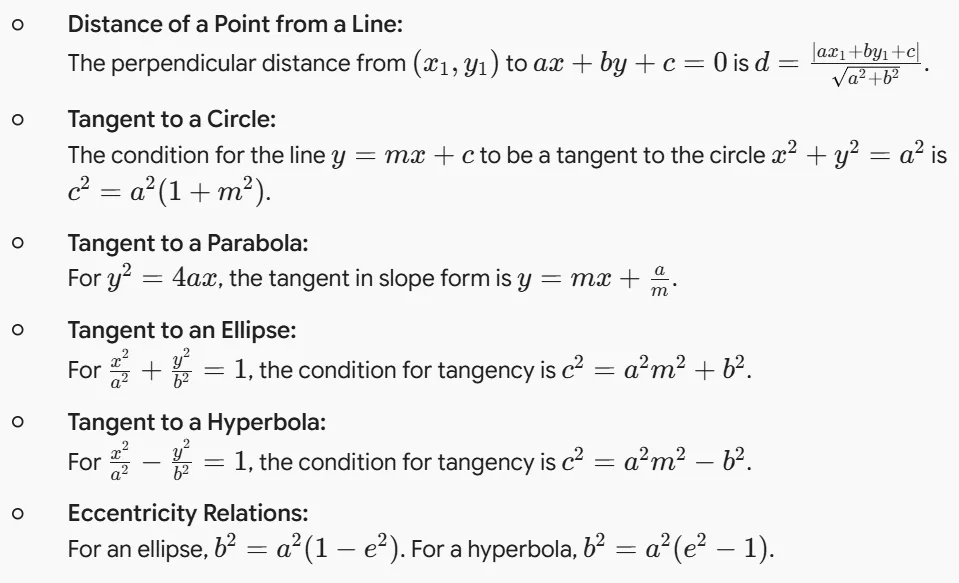
During the 180-minute computer-based test, deriving complex tangent conditions from scratch is a severe waste of time. Maintain a dedicated formula sheet and ensure the following relationships are memorized flawlessly:
Tactical Preparation and Execution Strategy
Securing marks in Coordinate Geometry requires a blend of rigorous algebraic discipline and spatial visualization.
Draw Rough Cartesian Sketches: Never attempt a locus, circle, or conic section problem without drawing a quick, rough sketch on your scratchpad. Visualizing the intersection of a line and a parabola, or the position of a focus relative to a directrix, prevents catastrophic setup errors and helps eliminate illogical MCQ options immediately.
Master Parametric Coordinates: Using parametric coordinates (like $(a\cos\theta, b\sin\theta)$ for an ellipse) drastically simplifies the algebra compared to using standard $(x, y)$ Cartesian variables, especially in questions involving tangents and normals.
Beware of Calculation Traps: Coordinate Geometry numericals frequently involve heavy algebraic expansions, quadratic equations, and complex roots. Ensure your calculation speed is flawless to avoid silly decimal or sign errors, as Section B carries a strict -1 negative marking penalty.
Conclusion
Mastering JEE Main Maths: Coordinate Geometry is an absolute strategic necessity for crossing the 99th percentile threshold. Because this block relies heavily on standard formulas and predictable tangent properties, it provides an incredible return on your invested study time. Conic Sections form a predictable high-return block, and mastering the analytical properties of tangents, normals, and common chords guarantees reliable marks. Maintain clean, disciplined calculations to avoid negative marking, meticulously track your progress, and secure these guaranteed 16 to 24 marks to build immense confidence on exam day.