By DekhoCampus Editorial ·
JEE Main Chemistry: Solutions and Colligative Properties
Master Solutions and Colligative Properties for JEE Main 2027. Review essential formulas, Raoult's law, the van 't Hoff factor, and numerical strategies.

Mastering Solutions and Colligative Properties is essential for maximizing your Physical Chemistry score in the Joint Entrance Examination (JEE) Main. This chapter consistently provides 1 to 2 direct numerical questions per shift, often populating the calculation-heavy Section B. Unlike abstract theoretical chapters, this unit relies on straightforward physical laws and precise algebraic manipulation, making it a highly reliable source of marks if your decimal accuracy is sound.
Core Syllabus Breakdown
To navigate this chapter efficiently, candidates must compartmentalize the syllabus into three interconnected areas.
Concentration Terms and Temperature Dependence
Before tackling complex mixtures, you must be fluent in expressing concentration. Questions frequently require rapid conversions between molarity, molality, mole fraction, and mass percentage. It is highly critical to remember which terms are temperature-dependent and which remain constant regardless of thermal changes. Because molarity involves volume (which expands or contracts with heat), it changes with temperature. Molality and mole fraction rely exclusively on mass, making them temperature-independent.
Raoult’s Law and Liquid Mixtures
This segment tests your understanding of vapor pressure in liquid-liquid solutions. You must be able to apply Raoult's Law to calculate the total vapor pressure of a mixture. Furthermore, graphical questions evaluating positive and negative deviations from Raoult's Law (non-ideal solutions) and the formation of azeotropes are heavily tested theoretical concepts. You must know standard examples of these deviations, such as the ethanol-water mixture (positive deviation) and the chloroform-acetone mixture (negative deviation).
Colligative Properties and the van 't Hoff Factor
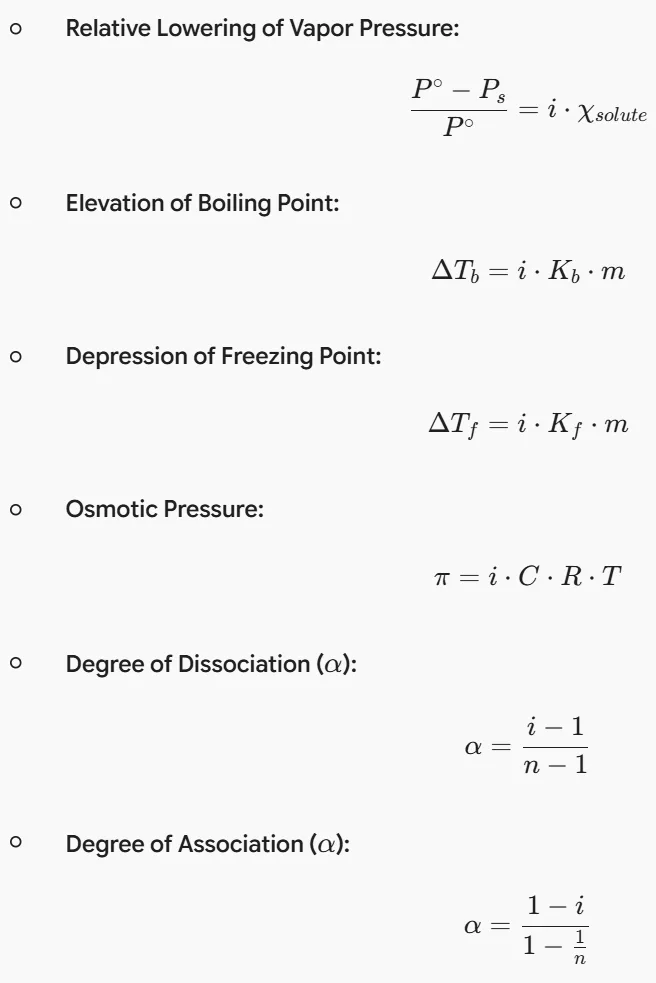
This is the mathematical core of the chapter. Colligative properties depend entirely on the number of solute particles, not their chemical nature. You must master the relative lowering of vapor pressure, elevation of boiling point, depression of freezing point, and osmotic pressure. The National Testing Agency (NTA) rarely asks questions about simple non-electrolytes. You are almost guaranteed to encounter electrolyte solutions where the solute undergoes dissociation (e.g., NaCl) or association (e.g., acetic acid in benzene). Applying the van 't Hoff factor to all colligative property formulas is non-negotiable.
Essential Formulas for Instant Recall
During the 180-minute exam, deriving formulas is a severe waste of time. Maintain a rapid-recall sheet for the following standard equations:
Tactical Preparation and Accuracy
To secure the marks offered by this unit, your preparation must focus on eliminating calculation errors. Numerical questions here often feature complex decimals involving the universal gas constant, ebullioscopic constants, or cryoscopic constants. Always maintain strict unit discipline, converting temperatures to Kelvin and volumes to liters where appropriate before initiating your calculations. Track your arithmetic mistakes meticulously during mock tests to ensure you refine your accuracy before the actual exam day.
Conclusion
Securing a high percentile in Physical Chemistry depends on turning conceptual knowledge into rapid, accurate numerical execution. By heavily prioritizing the van 't Hoff factor, mastering inter-concentration conversions, and understanding the theoretical deviations of Raoult's Law, you establish a foolproof foundation for this chapter. Execute your mock test calculations without digital aids to simulate the CBT environment, and you will confidently clear these high-yield questions on exam day.